
Final model steering evolution
Although the EPS unit part number for the NSX's power steering control unit varies by year and model, there are three main types based on their configuration and control method: early models (100-120 models, NA1), mid models (130 models, NA1), and later models (NA2 and later).
While the gearbox's internal motor, gears, and other mechanical components are common to all models, they can be divided into two types: early and later models, based on the torque sensor signal output and the presence or absence of a rotation sensor.
The torque sensor detects the amount of force applied to the steering wheel, whether left or right.
Early models had issues with the EPS unit's response speed, so the gearbox torque sensor included a delay in the signal.
Late-model power steering, on the other hand, eliminated the delay circuit for the gearbox torque sensor signal due to the evolution of the EPS unit, which can now handle sensitive signal changes.
Due to more precise torque sensor control, control is now solely via the torque sensor, and the rotation sensor has been eliminated from the gearbox.
These changes improved the responsiveness of the later-model power steering, so that power assist kicks in the moment you turn the steering wheel, resulting in a noticeably lighter steering feel.
Improved steering feel via control
By changing the wiring, it's possible to combine an early-model power steering gearbox, which has a delay in the torque sensor signal, with a later-model EPS unit. In addition to responsiveness issues, early-model power steering suffers from a sudden loss of assist at around 40 km/h, a speed well within reach even for city driving, creating a rather unnatural feeling. With the mid-model 130 and later models, the sudden loss of assist at around 40 km/h has been eliminated, resulting in a more natural feeling where assistance gradually decreases until the assist stops at around 80 km/h. The combination of a later-model gearbox without a torque sensor delay circuit and a later-model EPS unit offers the most responsiveness of the three generations of power steering, providing a smooth, natural feeling of power assist. While it's best to upgrade to a later-model unit, including the gearbox, I've heard that simply upgrading the control system to a later-model unit can significantly improve the feel, so I acquired a later-model power steering unit and stocked it, hoping to do so someday.
| Classification | Model year | Model | Model | EPS unit | Power unit | Power steering gearbox |
|---|---|---|---|---|---|---|
| Early model | 1991 | NSX | 100 type NA1 | 39980-SL0-013 | 53190-SL0-003 | 53601-SL0-325 (*3) Torque sensor and rotation sensor combined use |
| 1993-1994 | NSX | 110-120 type NA1 | 39980-SL0-000 | |||
| Mid-term model | 1995 | NSX NSX-T | 130 type NA1 | 39980-SL0-305 | None (integrated) | |
| later-model | 1997 | NSX, NSX-S, NSX-T | NA2 (※1) | 39980-SL0-043 (※2) | None (integrated) | 53601-SL0-040 (*4) Torque sensor only |
| 2000-2002 | NSX, NSX-S, NSX-T | NA2 (※1) | 39980-SL0-053 | |||
| 2004 | NSX and NSX-S | NA2 (※1) | 39980-SL0-073 | |||
| 2004 | NSX-T | NA2 (※1) | 39980-SL0-A03 |
*1 Including AT model (NA1)
*2 Integrated into 39980-SL0-053
*3 Old product numbers: 53601-SL0-000 and 53601-SL0-315
*4 Old part number: 53601-SL0-010 (1997-2001), 53601-SL0-020 (2002-2004)
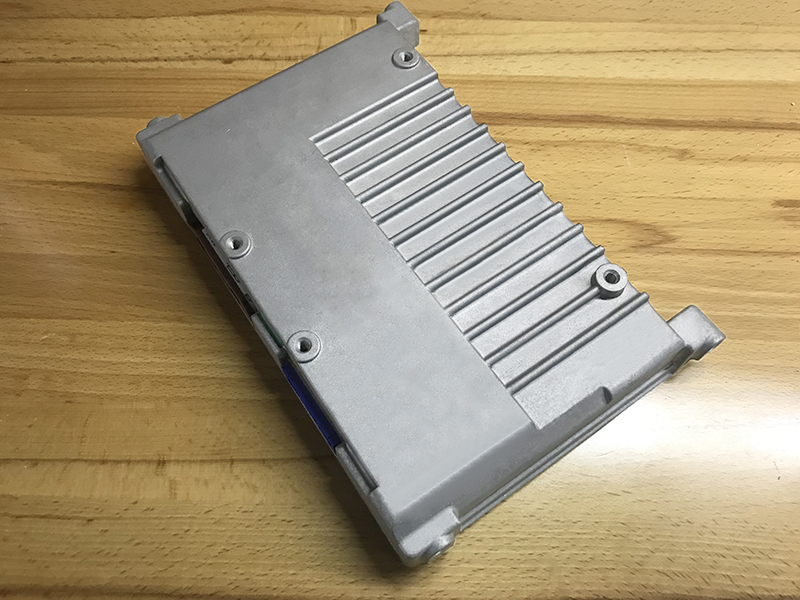
later-model EPS unit 39980-SL0-053
- The part number of the later-model unit I obtained was "39980-SL0-053."
While "39980-SL0-053" and "39980-SL0-073" were available, I had heard that "39980-SL0-053" had a simpler error code and was more suitable for replacement, so I chose "39980-SL0-053."
The unit with part number "39980-SL0-023," currently part number "39980-SL0-305," was used in early 130-type (mid-model) vehicles, but has since disappeared from the parts list. While
the exact reason for its disappearance is unclear, it appears that there was a fatal problem with the EPS unit itself, causing errors when tires with wider or better grip than stock were fitted, increasing the load on the power assist. Apparently, a free replacement was offered overseas. Also, this problem seems to have continued until the early model of NA2 (39980-SL0-043), so it seems that the replacement base would be "39980-SL0-053" or "39980-SL0-073".
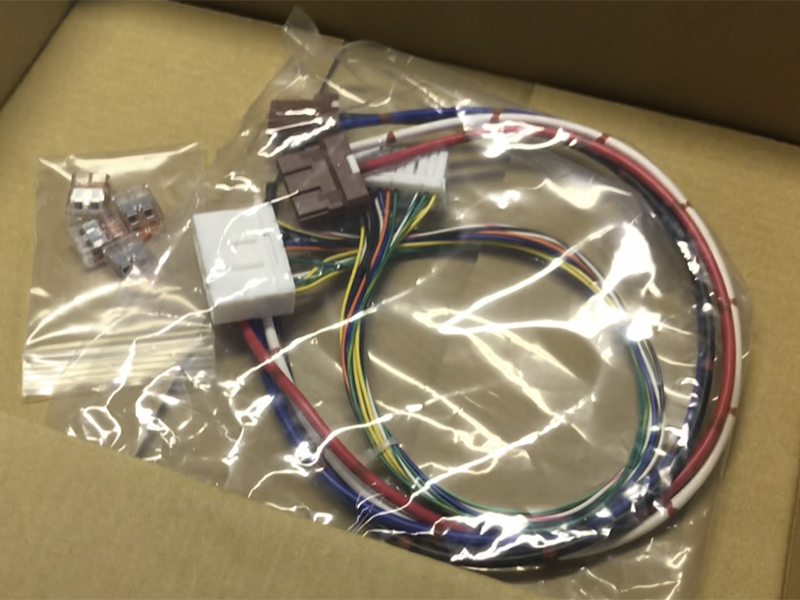
T3TEC Power Steering Harness T3-H-PW02
- I considered making my own harness for the conversion, but T3TEC has
a power steering conversion harness for the early model to later-model (product number: T3-H-PW02)open_in_new.
Therefore, I decided to purchase it instead of researching and fabricating one myself. Incidentally, this harness doesn't take into account the wiring connecting to the rotation sensor, so it's not compatible with mid-model EPS unit upgrades.
My NSX is equipped with a 4.2 final drive unit for the NSX-R. When I combined the NSX-R's 4.2 final drive unit with a later-model EPS unit, a discrepancy occurred between the signals from the main speed sensor (VSS1) and the NC speed sensor (VSS2), which counts the number of teeth on the ring gear. This caused an error and the check steering light to come on when the actual vehicle speed approached 100 km/h.
While there's no established way to completely avoid this error, I took advantage of the system behavior in which the warning light illuminates when an error occurs, but EPS control is disabled only after an engine restart. By disconnecting the warning light and backup power supply via the wiring from the EPS unit, the warning light would not come on and the power steering would function without any problems.
Also, early model manual transmission vehicles are not equipped with an NC speed sensor (VSS2), so if you want to retrofit power steering you will need to install an additional sensor, but by using the specifications above you can install power steering without an NC speed sensor.
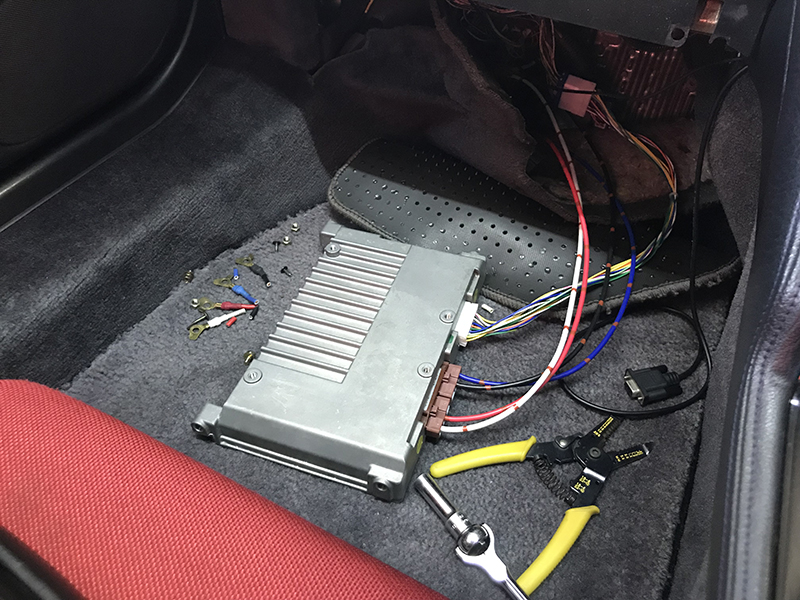
Installed with temporary wiring to check operation
- The later-model EPS unit is slightly smaller than the earlier model power unit, so the lower bracket is different.
When I tried to purchase one, I was told that the delivery date was undetermined. I was able to place an order, so I decided to replace it with temporary wiring and wait for it to arrive.
In the end, it took about a year for it to arrive, but since it is no longer in production, I was lucky to be able to purchase it (I think the one I bought was probably the last production run).
Currently, the EPS unit itself is no longer in production and difficult to obtain, but if you just want the bracket, you can purchase the Bracket B EPS Unit (product number: T3R39982SL0000)open_in_new sold by T3TEC.
The power unit for the early model uses round terminals for connection, but the conversion harness comes with a one-touch connector for wiring processing, so the conversion work did not take long.
The test drive gave me an extremely good feeling. I highly recommend it, as it makes a big difference even when just driving around town.
I was hoping to eventually replace the gearbox with a later-model, but I was hesitant because it was a fairly expensive part, costing 404,800 yen as of October 2025.
However, with the significant price increase in January 2026, the hurdle has become even higher.
One problem is that the EPS unit for later models has been discontinued, but the power steering gearbox for earlier models has also been discontinued, so if the power steering gearbox for earlier models breaks down, it cannot be repaired with the gearbox for later models, which does not have a rotation sensor.
T3TEC has apparently dealt with this situation by transplanting the rotation sensor removed from an earlier model into the gearbox for later models.
Loading...
| No | Part Number | Part Name | unit price | quantity | price | remarks |
|---|---|---|---|---|---|---|
| 1 | 53601-SL0-040 | Box assembly, power steering gearbox | 1 | |||
| Total amount | ¥0 | |||||
*All prices shown include tax.
*Parts with blank unit prices are either out of production or unavailable for order at the time of the survey.
*Even if a part has a unit price displayed, it may no longer be in production.
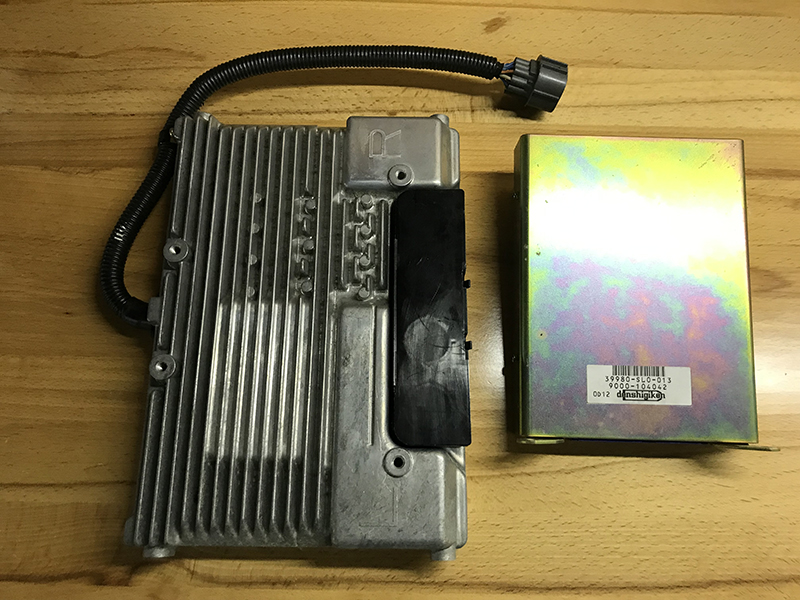
Removed early model power unit and EPS unit
- The early model power unit and EPS unit have been removed. The later-model does not require an EPS unit, so the wiring is neater and lighter.
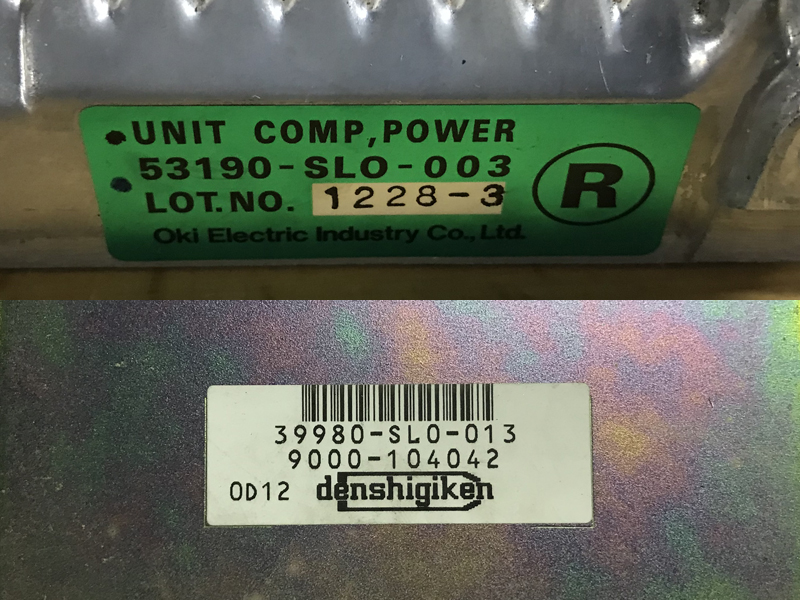
Early Model Driver and Computer Part Numbers
- The part numbers of the removed drivers and computers are as follows: Early model power unit 53190-SL0-003 Early model EPS unit 39980-SL0-013
- I compared the bracket I purchased for the later-model (39982-SL0-000 Bracket B, EPS unit) with the bracket for the earlier model.
The bracket for the later-model is unplated, likely to reduce costs. The unit mounting area appears to be the same at first glance, but the later-model EPS unit is smaller, so the distance from the main body fixing point to the lower screw hole is longer. - The later-model bracket has one additional pair of stays. These are thought to be fixing holes for harnesses, etc., but the details are unknown as there is nothing to fix to the earlier model vehicle in the first place.
- The later-model bracket does not have the weld nuts that were present on the earlier model, and the holes for fixing the harness have been moved to the center.
There were no weld nuts attached to the bracket on my vehicle, so I didn't know what they were for.
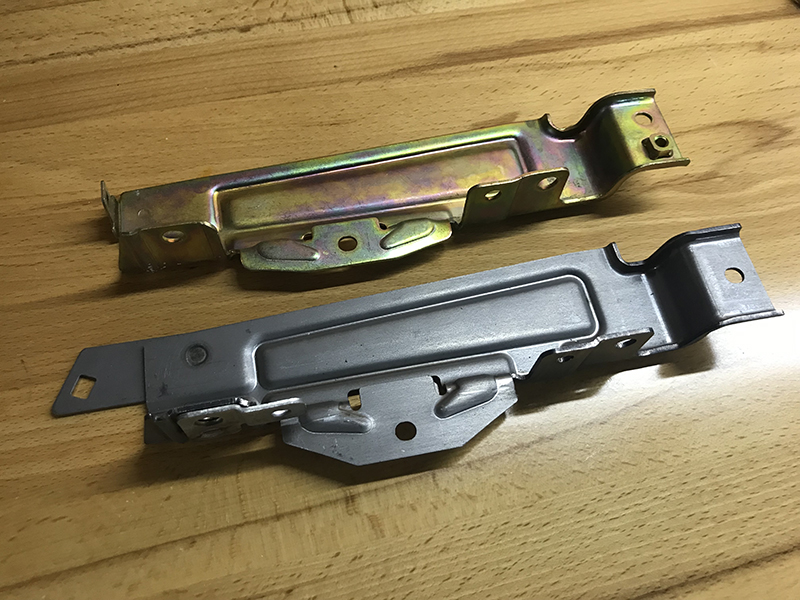
Early (top) vs later model bracket (bottom)
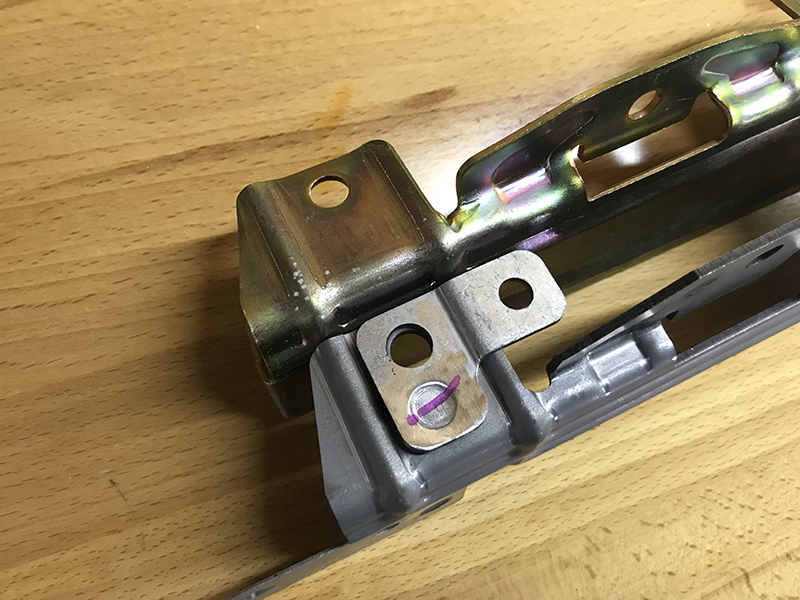
A stay has been added to the later bracket.
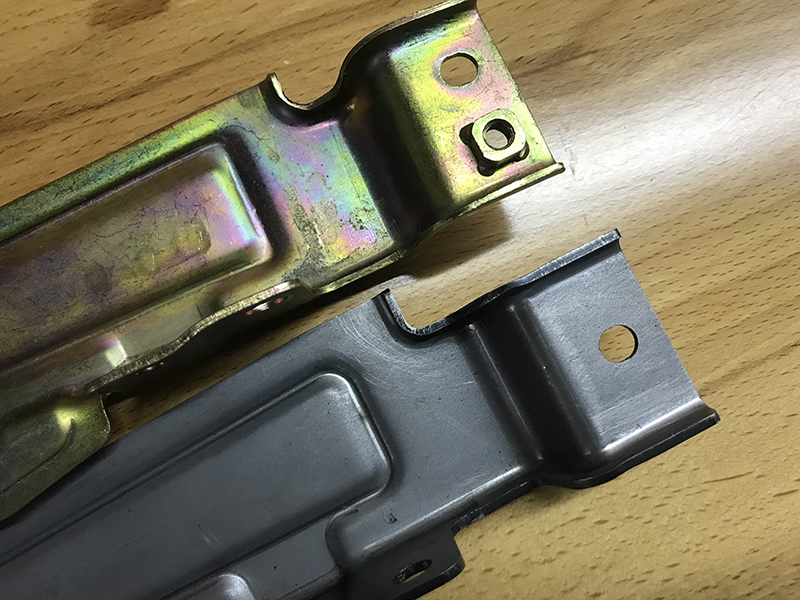
The later brackets do not have weld nuts
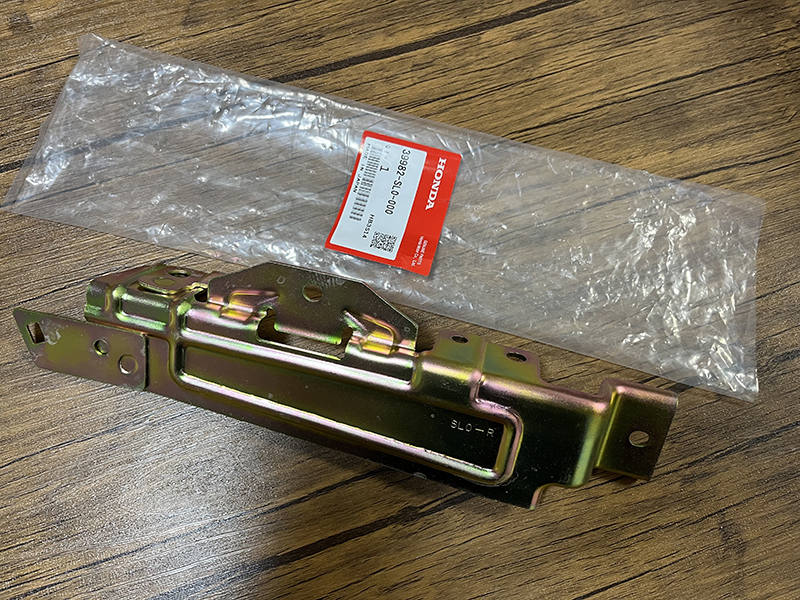
Chromate-plated bracket for later models
- Since the later-model brackets were solid and I didn't want them to rust, I applied chromate plating to them, just like the earlier models.
I believe the earlier brackets were hexavalent chromate, but due to environmental regulations, there are currently very few contractors in Japan that can do this, so I applied trivalent chromate.
Immediately after the switch from hexavalent chromate to trivalent chromate, the result was not as vibrant a gold as hexavalent chromate, but rather something between gold chromate and chromium plating, and the difference was easily visible.
However, although the durability of the coating is inferior to that of hexavalent chromate, technological advances such as the multi-layer coating structure and the introduction of colorants have resulted in a vibrant gold color close to that of hexavalent chromate, as shown in this photo.
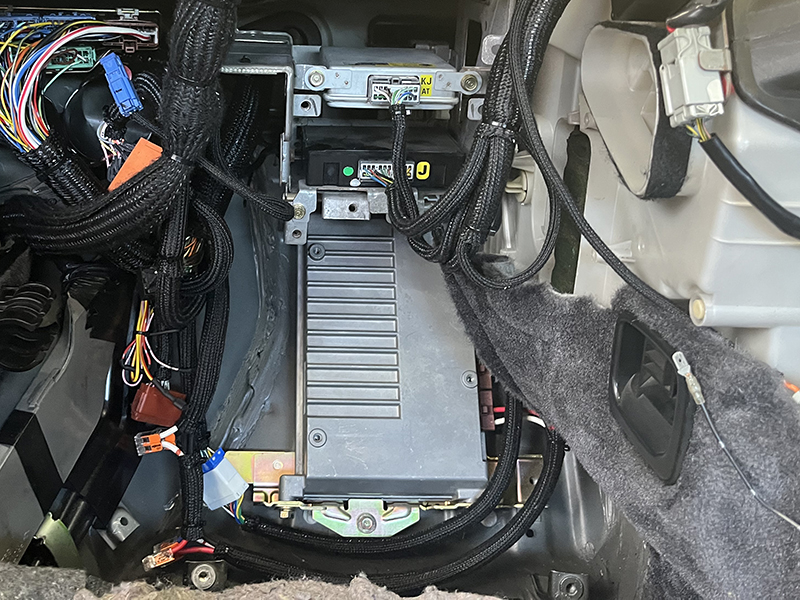
Fix the later EPS unit in the correct position
- With the bracket ready, I fixed the unit in the correct position (at the time of the photo shoot the dashboard had been removed to replace the fabric, but the EPS unit can be installed simply by removing the glove box).
I was lucky enough to be able to replace it with a later-model unit, but since EPS units are no longer in production, if you can get your hands on a mid-model unit (39980-SL0-305), it might be worth trying to combine an early model power steering gearbox with a mid-model EPS unit. - The thickness of the genuine woofer bracket is 15mm. If the woofer is not installed, you can use a 15mm spacer to fix the unit cover in the correct position.
- I secured the unit cover in place using a 15mm M6 spacer sold on Amazon.
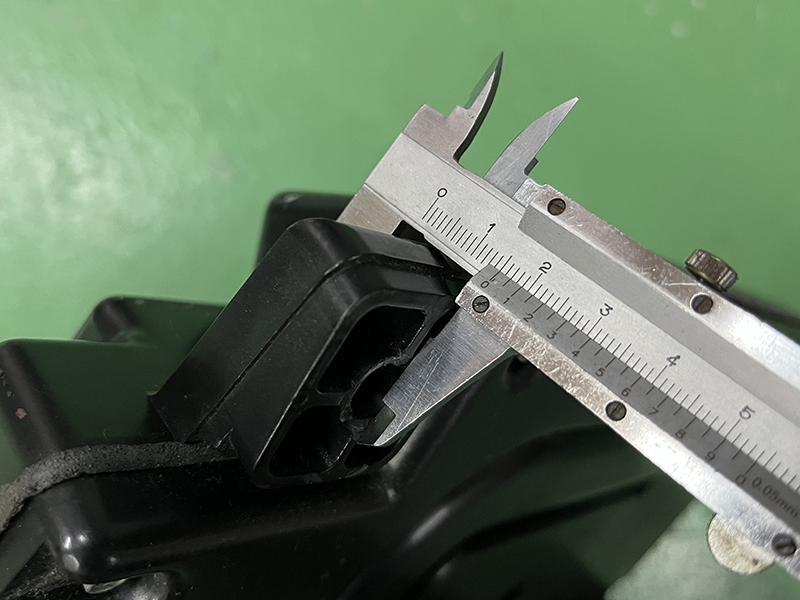
Thickness of genuine woofer bracket: 15 mm
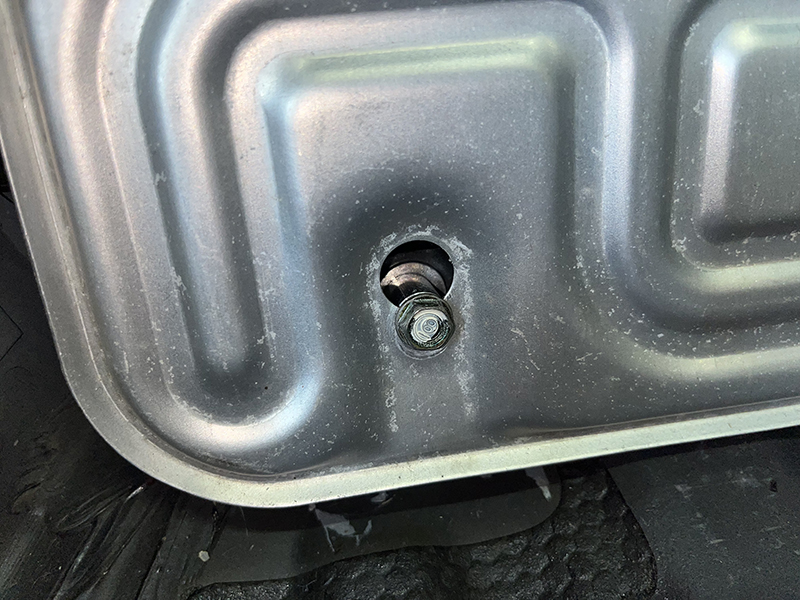
Attach unit cover with 15 mm spacer