
Brake Changes with the NA2 Debut
The NSX received revised brakes with the model introduced in February 1997, including larger rotors and revised piston diameters.
These brakes are often called "NA2 brakes," but even after the NA2 debuted in 1997, C30A-powered automatic models retained the NA1 designation (140 and 150 series), so "late-model brakes" may be a more accurate term.
Late-model brakes have larger rotors at both ends, but this does not simply mean greater braking force.
At the front, rotor diameter increased from 282mm to 298mm, but the smaller piston was actually reduced from 36.1mm to 33.9mm, a caliper-side change that reduces braking force.
At the rear, rotor diameter increased from 282mm to 303mm, and the piston was also enlarged substantially (with cylinder bore diameter increasing from 42.8mm to 48.1mm).
Comparison of Service Manual Specifications
| NA1 (100-130 series) | NA2 (140-150 series NA1) | ||
|---|---|---|---|
| Front | Pad dimensions | 132.4 × 55.0 × 11.0mm | 131.7 × 53.5 × 11.0mm |
| Pad area | 58cm2 | 56cm2 | |
| Effective disc diameter | 232mm | 250mm | |
| Disc outside diameter (*) | 282mm | 298mm | |
| Wheel cylinder bore diameter | 36.1mm + 40.4mm | 40.4mm + 33.9mm | |
| Rear | Pad dimensions | 88.8 × 51.5 × 9.5mm | 61.8 × 51.5 × 9.5mm |
| Pad area | 37cm2 | 31cm2 | |
| Effective disc diameter | 228mm | 249mm | |
| Disc outside diameter (*) | 282mm | 303mm | |
| Wheel cylinder bore diameter | 42.8mm | 48.1mm | |
* Disc outside diameters were measured, as they are not listed in the service manual.
Hydraulics Also Affect Brake Bias
Judging by the numbers alone, the front brakes appear to have been adjusted to provide similar braking force on early and late models, while the late-model rear brakes appear substantially stronger.
Converting an NSX to late-model brakes is said to improve rear braking. The differences in piston and rotor diameters make this understandable, but the hydraulic system also needs to be considered when assessing how the resulting front-to-rear balance differs from the factory late-model setup.
Early ALB-equipped cars are described as having no proportioning valve and applying the same hydraulic pressure to the front and rear brakes. Late ABS-equipped cars, on the other hand, have a proportioning valve that is thought to limit rear hydraulic pressure.
Consequently, converting to late-model brakes while retaining the early ALB plumbing may produce a more rear-biased balance than the factory late-model setup. Reproducing the factory late-model balance intended by the manufacturer would seem to require considering the late ABS proportioning valve as well.
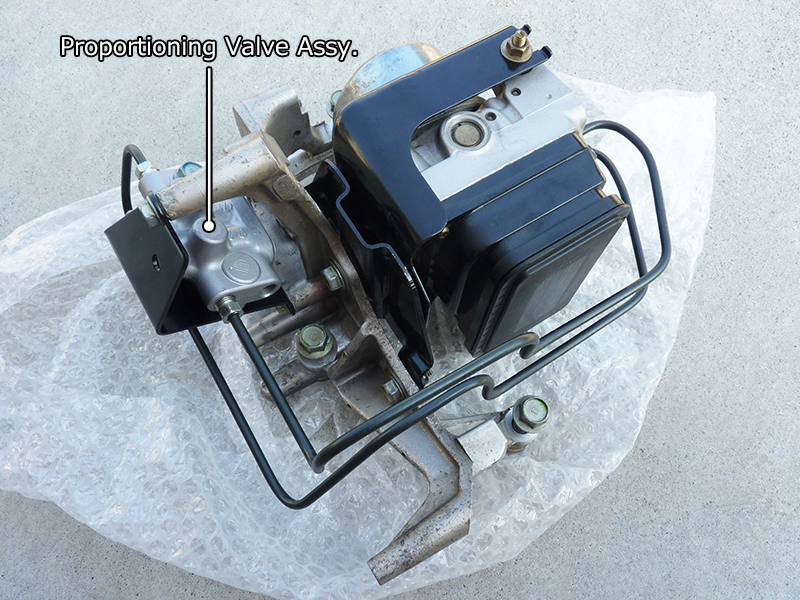
Late ABS Proportioning Valve Assy.
For the front brakes, aftermarket opposed-piston calipers paired with large rotors of 330mm or more are also an appealing option.
However, there are various accounts of front Brembo installations shifting brake bias toward the front, requiring an adjustable proportioning valve to move the balance rearward.
Since front-to-rear balance matters more than braking force alone, I decided to start by calculating the differences between early and late brakes using the service manual specifications.
The service manual lists the "effective disc diameter," which indicates where the braking force from the pads acts. This value and the caliper piston area can be used to calculate theoretical braking torque at equal hydraulic pressure and coefficient of friction.
I calculated each combination and compared the differences, taking the factory late-model brakes as "1."
The late-model brakes used as the reference assume plumbing that incorporates the late ABS proportioning valve.
Theoretical Braking Torque Comparison, with Factory Late-Model Brakes Set to "1"
| Front | Rear | ||
|---|---|---|---|
| Brake configuration | Braking force | Brake configuration | Braking force |
| Caliper:OEM NA2 / NA1 140+ Rotor:OEM NA2 / NA1 140+ Ø298 mm | 1 | Caliper:OEM NA2 / NA1 140+ Rotor:OEM NA2 / NA1 140+ Ø303 mm | 1 |
| Caliper:OEM NA1 100–130 Rotor:OEM NA1 100–130 Ø282 mm | 0.979 | Caliper:OEM NA1 100–130 Rotor:OEM NA1 100–130 Ø282 mm | 0.725 |
| Caliper:OEM NA1 100–130 Rotor: GAREGE KITE Ø330 mm (*1) | 1.190 | Caliper:OEM NA1 100–130 Rotor: GAREGE KITE Ø340 mm (*1) | 0.910 |
| Caliper: SPOON monoblock (*2) Rotor:OEM NA1 100–130 Ø282 mm | 0.871 | - | - |
| Caliper: SPOON monoblock (*2) Rotor:OEM NA2 / NA1 140+ Ø298 mm | 0.938 | - | - |
| Caliper: SPOON monoblock (*2) Rotor: Biot offset kit Ø330 mm (*1) | 1.058 | - | - |
| Caliper:OEM NA2 / NA1 140+ Rotor: Biot offset kit Ø330 mm (*1) | 1.128 | Caliper:OEM NA2 / NA1 140+ Rotor: Biot offset kit Ø340 mm (*1) | 1.123 |
*1 Effective diameter is estimated assuming that the caliper bracket moves the pad center outward by half the increase in rotor outside diameter
(front effective diameter: 250 + 32 = 282mm; rear effective diameter: 249 + 37 = 286mm).
*2 Theoretical braking torque is calculated using four 36.12mm pistons, accounting for the difference between sliding and opposed-piston calipers.
Late Models Have Stronger Rears
Comparing early and late brakes, theoretical front braking torque increases by only about 2.2% on the late model.
Front piston area is about 5% smaller, so the design offsets the braking force gained from the larger rotor by reducing piston size.
At the rear, however, the larger piston and rotor increase theoretical braking torque by about 38%.
In other words, it appears that the front rotors were enlarged to improve heat resistance while keeping braking force almost unchanged, whereas rear braking force itself was substantially increased.
Aftermarket Brake Setups
To see what differences aftermarket parts would make, I also calculated combinations using the Garage Kite big rotor kit (now discontinued), the Biot brake offset kit, and SPOON monoblock calipers, which are also available for the NSX.
Even with rear rotors enlarged to 340mm, retaining the early rear calipers does not match the theoretical braking torque of the factory late-model brakes. Bringing the front-to-rear balance closer to the factory late-model setup while upgrading the fronts would therefore seem to require changing the rear calipers as well.
Choosing Late-Model OEM Brakes
Aftermarket opposed-piston calipers are an option at the rear as well, but the cost of adding separate parking brake calipers and other items makes factory late-model calipers the most practical choice in my view.
At the front, aftermarket opposed-piston calipers are also an option provided they do not significantly upset the front-to-rear balance. However, factory calipers offer a wide selection of model-specific brake pads, making maintenance and pad changes to suit different uses straightforward.
I also wanted to get a proper feel for the factory late-model brakes themselves. Taking all of these factors into account, I decided to begin by converting both front and rear to factory late-model brakes.
If I then find myself dissatisfied with their appearance, performance during sustained driving, or other aspects, I would like to consider a big rotor kit that retains the factory calipers (front: 330mm; rear: 340mm) as the next step.